
 return
Pursuing Shared Value: Introducing "Public Welfare" Thinking into Business Operations
On November 22, 2014, the 14th China MBA Development Forum and Peking University Guanghua MBA 20th Anniversary Celebration opened at the Qiu Deba Gymnasium of Peking University. Mr. Shen Guojun, Chairman of Yintai Group, Founder and Honorary Chairman of Yintai Public Welfare Foundation, was invited to attend the main forum with the theme of "New Management and New Thinking" and delivered a keynote speech entitled "Pursuing Shared Value: Introducing 'Public Welfare' Thinking into Business Operations". In addition, Liu Wei, Executive Vice President of Peking University, Li Yining, Honorary Dean of Peking University Guanghua School of Management, Qian Yingyi, Dean of Tsinghua University School of Economics and Management, Cai Hongbin, Dean of Peking University Guanghua School of Management, Ren Huichuan, General Manager of Ping An Group, and many other well-known scholars and entrepreneurs attended the forum and delivered speeches to congratulate them.
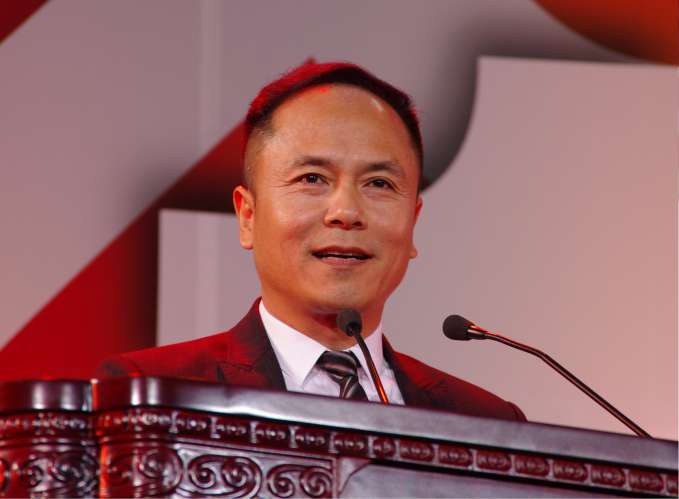
In traditional concepts, business and public welfare are often seen as opposing, with businesses being perceived as prioritizing profit over public welfare. Mr. Shen Guojun, however, does not think so. He believes that enterprises should "pursue shared value and do business with a 'public welfare' mindset," which will surely usher in the next wave of innovation.
Shared value is not simply a corporate social responsibility, but a new way to achieve economic success. Eliminating the shadow of 'charity is just a corporate promotional activity', shared value should be the core operational activity of enterprises, which will surely lead the next round of business thinking transformation and rebuild the bridge between business success and social progress.
The new generation of consumers and producers, namely the post-90s generation of young people in China, possess new behavioral traits such as familiarity with the internet, global awareness, freedom from traditional ideas, concern for social and public interests, and attention to personal rights. These distinct behavioral traits provide a broad soil for the application of shared value. Future enterprises must re integrate their commercial and social interests to cope with rapidly changing consumer groups. Enterprises should apply the "public welfare" thinking of shared value to the level of business strategy, striving to create enormous economic value in the process of meeting social needs, and achieve the maximum intersection of business and public interests. The pursuit of shared value by enterprises is not just about donating money or goods for charity, but also a new way to achieve economic success.
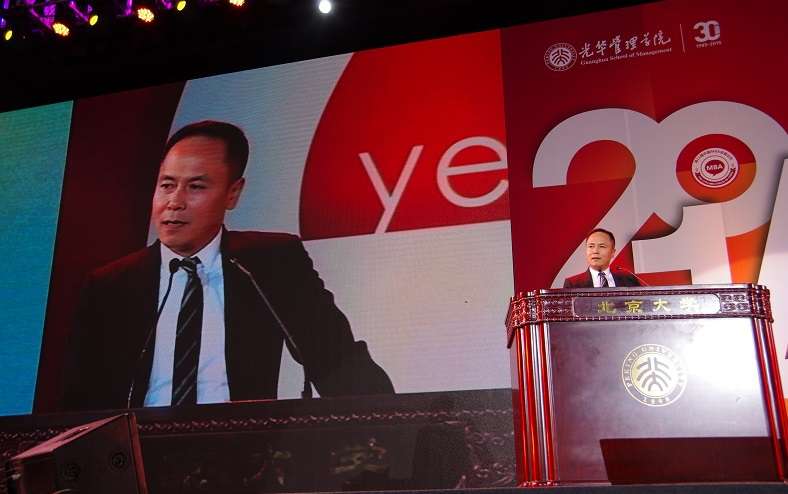
Mr. Shen Guojun also elaborated on how to create shared value through three major approaches, namely rethinking products and markets, redefining productivity in the value chain, and promoting overall social development. The creation of shared value is an important means for future enterprises to achieve their own sustainable development.
Firstly, companies should rethink their products and markets, and strive to capture some extremely important but unmet universal needs, regardless of their size. Products designed with the aim of creating public welfare value for society in response to these needs will undoubtedly have strong vitality and create unique competitive advantages for enterprises to formulate strategies, win development opportunities, and earn profits
Secondly, the intersection between social progress and the value chain of enterprises is far beyond people's imagination, and enterprises should redefine the productivity on the industrial value chain. Once enterprises adopt a shared value mindset to address and further innovate in resolving social conflicts, the harmony between enterprises and society will be greatly enhanced. If a company can build a value chain (including products, distribution, logistics, etc.), there will be more opportunities to create shared value, such as reducing energy consumption in transporting goods, reducing environmental pollution through recycling of raw materials, and better reusing water resources.
Thirdly, enterprises should regard promoting the overall development of society as a belief, rather than seeing themselves as individual entities. Enterprises are a part of society, and the enterprise value chain system, logistics system, or supplier system established through cooperation between enterprises, governments, and the public will have a positive impact on the entire social division of labor mechanism, social system, and lifestyle. At the same time, it will greatly improve the production efficiency and capacity of enterprises, and further create a positive ecological environment for the virtuous cycle and development of the social environment.
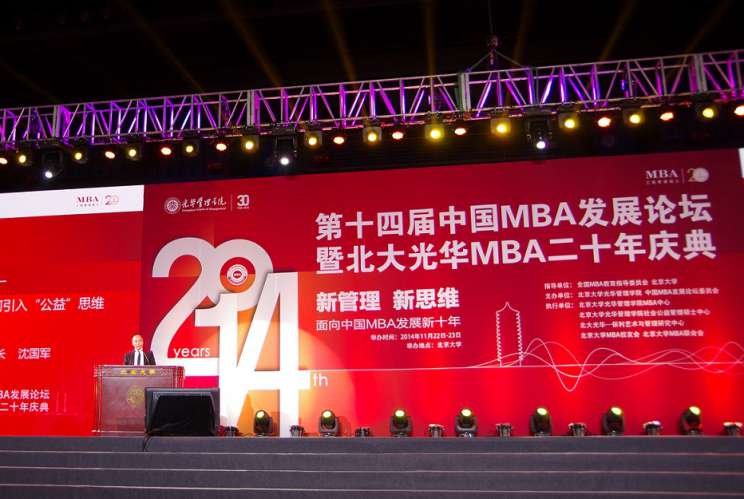
At the end of his speech, Mr. Shen Guojun congratulated the 20th anniversary of the establishment of the MBA program at Peking University Guanghua School of Management. He wished the China MBA Development Forum a complete success and wished that business education in China could reach new heights and cultivate more future leaders!
Speech background:
2011 In, Professor Michael Porter of Harvard Business School proposed the concept of "shared value": if the industry can combine its business goals with social goals, it can better address key global challenges and be the most competitive future business model. See Wikipedia for details: http://en.wikipedia.org/wiki/Creating_shared_value 。
The China MBA Development Forum was initiated by Peking University in 2000 and has been successfully held for 13 sessions in 13 well-known universities across the country. It has gained high recognition from all sectors of society and has become an authoritative platform for MBA students nationwide to jointly build the "China MBA" brand. It is also an important platform for information exchange, academic interaction, and career development among Chinese MBA students. This forum is the 14th China MBA Development Forum, coinciding with the 20th anniversary of the founding of the Peking University Guanghua MBA program. See
http://30th.gsm.pku.edu.cn/zt/mba20/ 。